Subscribe
Sign up to stay up to date with umanitek's latest developments.

Sign up to stay up to date with umanitek's latest developments.
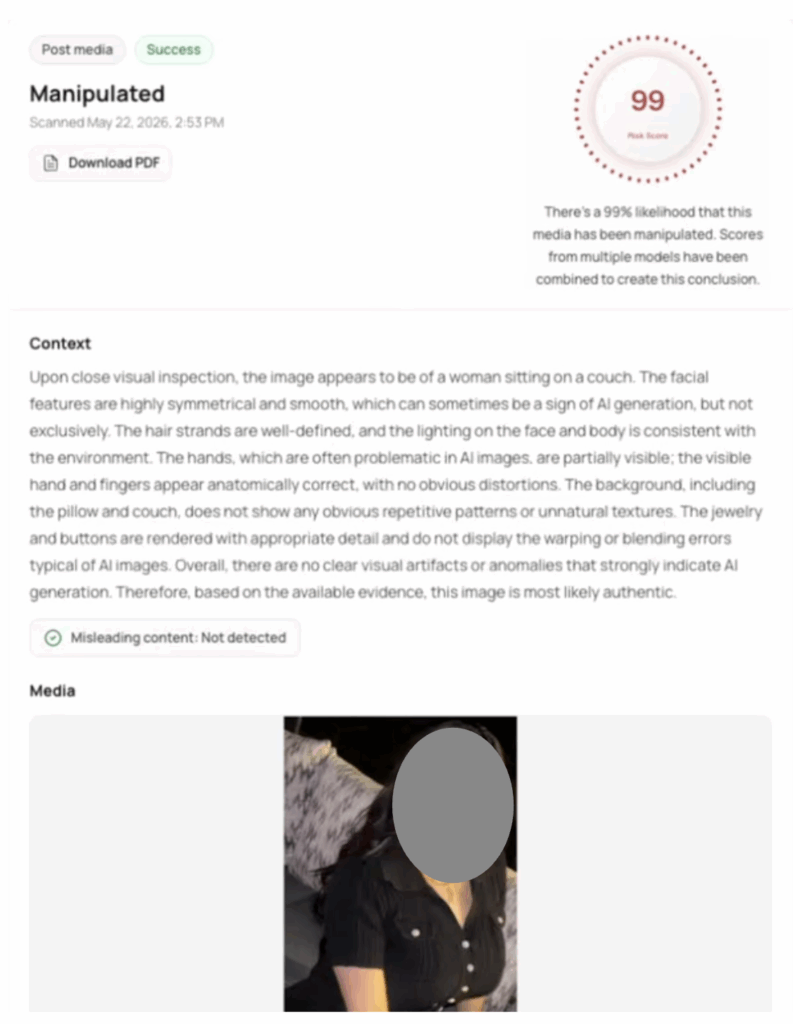
Umanitek has an upgrade to its Guardian Agent that issues a verifiable, forensically defensible certificate for detected piece of content, stating whether the content is authentic or AI-manipulated. Each certificate is anchored in Umanitek’s Decentralized Knowledge Graph (DKG), making it independently auditable and resistant to tampering – a first for the deepfake detection space.
The upgrade integrates Reality Defender’s deepfake detection technology directly into the Guardian Agent’s verification pipeline, enabling Umanitek to classify synthetic media when a user requests verification of suspected content.
The Guardian Agent detects harmful content across platforms, classifies the abuse, and supports takedown and evidence gathering workflows. It can now also verify whether that content is AI-generated or manipulated, producing a structured, evidence-backed record alongside each case.
As generative tools become more convincing, acting on trustworthy evidence matters more than ever – and verification adds another layer to the cases Guardian already builds.
The DKG-anchored PDF certificate is what makes the output defensible. Unlike a screenshot or an internal log, the certificate is cryptographically linked to immutable records, meaning its findings can be independently verified by platforms, regulators, or courts without relying on Umanitek as a single source of truth.
The Guardian Agent’s combined detection, verification, and enforcement pipeline is designed to shorten the window between when harmful content appears and when it can be acted on, reducing the time it has to spread.
Learn more about the Guardian Agent and request a demo at: https://www.umanitek.com/guardian