
The AI Defense Gap: Are We Building Protection as Fast as We Build The Power?
AI is spreading into everyday systems faster than we can protect them. Recent outages and attacks show the gap, and why defense has to keep pace.
Nov 20, 2026 · @Ida Malvik
Lately, ordinary conversations have taken a strange turn. Friends compare bunker plans. Governments prepare the public for what they should do if the internet went down for a week. Survival packs, once a niche hobby, now sell as everyday purchases.
This is not panic for its own sake. It is a reaction to something people can feel: the systems we depend on are more fragile than we thought, and the technology we are adding on top of them is more powerful than anything before it.
Cars came before seatbelts, social media came before any moderation rules, and even nuclear weapons were used before the treaties existed. The pattern is familiar: the power came first, and the treaties, safeguards and detection systems followed years later. The difference now is speed. AI is spreading into everyday systems in months, not decades. This time, we cannot wait for the damage before we build the protection.
Digital threats live in the same invisible cloud as the systems they disrupt. When something breaks, we often cannot tell at first whether it was a glitch, a hack, a scam or a machine. You cannot defend with your bare hands what you cannot see. So the question is: as we race to build AI that can do almost anything, are we building defenses that can keep up, in real time?
A few weeks that showed how fragile we are
In the space of a few weeks this autumn, system after system broke in very public ways.
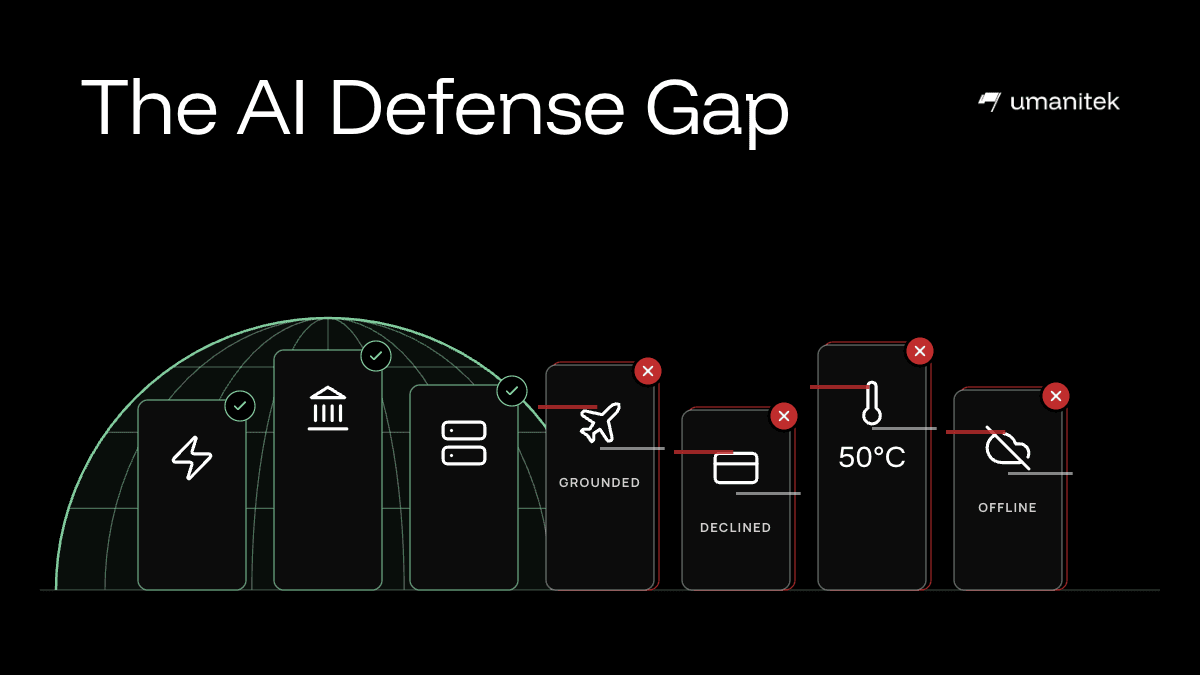
From 12 to 14 November, a Microsoft 365 outage cut off Outlook, Teams and Copilot for users in more than 70 countries. Some businesses fell back on fax machines to confirm trades.
On 13 November, the US Federal Aviation Administration stopped every departing flight in the country after data flooded its network. They reported approximately 12,462 cancellations, although not all were directly caused by the ground stop.
A few weeks earlier, supermarket freezers in France were hit by a suspected cyberattack. In early November it happened again in Belgium, Sweden, Ireland, Finland and beyond, with some units set to 50°C.
On 17 November, Equinor, Europe's largest gas supplier, detected an ongoing cyberattack on some of its IT systems. The threat was contained, and production remained unaffected with no indication of stolen or altered data.
In the same week in the US, United Airlines delayed departures and Apple's iCloud and Apple Pay went down. Officials say there is no evidence these outages were connected.
Some of these were attacks. Most were software bugs, overloads and network faults. That is exactly the point: our daily lives now run on systems that exist far from the physical world. Our money is a number in a database, and many of us no longer carry cash. When those systems stall, so do we. AI lives inside the machines. We do not. Now imagine the same weak points targeted by AI that can probe, adapt and strike at machine speed.
A cloud outage, a compromised refrigeration controller and a manipulated video require different defenses. Yet they raise a common question: how do we establish what can be trusted, detect when something goes wrong and respond before the damage spreads?
What a defense system can look like
Most of the AI conversation is about acceleration: how far, how fast, how much AI can catapult us forward. Far less attention goes to the defense layer that has to grow alongside it.
AI is the newest and fastest threat, but not the only one. Real-time digital protection rests on three ideas:
- Verify before you trust. Every command, account and piece of content should be able to prove its origin and show it has not been altered.
- Detect at machine speed. Continuously monitor and respond to threats before they spread.
- Preserve verifiable evidence. Document what happened and why, so detection can lead to accountable action.
As AI becomes more powerful and accessible, so do the risks of impersonation, manipulation, and digital deception. Detection alone is not enough. Identifying a threat means little if there is no way to act on it. The next phase of AI must be about building the infrastructure to defend trust in an increasingly synthetic world.
What Defense Looks Like in Practice
This is the challenge we are addressing at Umanitek.
Umanitek Guardian monitors for fake accounts, impersonation and harmful posts, and acts on them. When scammers launched waves of fake accounts impersonating crypto analyst CredibleCrypto, Guardian took down hundreds of them, with each takedown anchored to a verifiable record.
Guardian Agent Blackbox is a defense system for AI agents themselves. It acts as a shared memory across many agents, so one agent's lesson protects all of them, and keeps them from being tricked or compromised, with a live threat dashboard.
TrueSeal verifies content and helps expose deepfakes before they spread.
None of these slow AI down. They make it safer to move fast.
Are we prepared?
Bunkers and survival packs are a personal answer to a collective problem. They show that people sense the gap and prepare for it, but they do not know how to close it.
Closing it means treating defense as part of AI, not an afterthought. Every new capability should come with a way to verify it, monitor it and correct it in real time. We still have the chance to learn while we build.
Want to see real-time digital protection in action? Explore Umanitek Guardian at umanitek.ai.